World Story
Explore Ulvenor: its history, peoples, magic, and the fates that shaped the continent.
Introduction to the World

Welcome to the World of Howl of Eternity
Howl of Eternity is set on Oia, a world where old empires, ancient wrongs, divine powers, and dangerous magic still shape the lives of ordinary people. The known stories focus mainly on Ulvenor, the largest known continent, where humans, elves, dwarves, goblins, kobolds, orcs, centaurs, and other peoples fight for land, memory, faith, and survival. The present year is 1470 of the imperial calendar. The Empire of Magnursar still stands as the greatest human power on the continent, but it no longer feels untouchable. Border provinces are restless, old enemies are moving again, and rumors from the north speak of a Lich whose power may threaten more than one kingdom.
A World of Many Peoples
Ulvenor is not a world ruled by one race or one culture. Humans built kingdoms, cities, roads, and empires, but they are only one part of a much older story. Elves remember ancient forests and wars that began long before human chronicles. Dwarves guard halls beneath the mountains and alliances carved into stone. Kobolds and centaurs share the Great Plains through conflict, trade, and old claims. Goblins, orcs, naga kobolds, gnomes, drow, and other peoples live according to their own histories and laws. Every people has its heroes and crimes, its myths and practical needs. In Howl of Eternity, race is not only a character option. It is origin, memory, status, prejudice, kinship, and the first question many strangers ask before they decide whether to trust you.
Magic and Its Legacy
Magic exists, but it is never harmless. Before elemental magic spread across the continent, many peoples knew older traditions: shamanic rites, divine blessings, natural bonds, curses, sacred places, and powers that were not always understood as magic in the modern sense. Elemental magic changed the balance of the world when the Sorcer brought knowledge from beyond the Green Sea and gave humans a tool that could build, heal, burn, and conquer. Every spell draws on Essence, the living force behind magical power. A skilled mage can shape fire, water, lightning, darkness, mind, or physical force, but the body and soul pay for every act of power. Magic can save a city, win a battle, or destroy the person who tries to command it.
A World on the Edge of Change
The current age is not a time after the disaster. It is the tense moment before one. The Empire still collects taxes, roads still carry caravans, temples still celebrate holy days, and nobles still argue over titles. Yet the old order is under strain. The Lich rises in the frozen north, orc tribes stir in the east, kobolds and centaurs keep the Great Plains in permanent tension, and smaller states watch the Empire for weakness. This is the world into which adventurers step. Great powers are too slow to be everywhere, and the future often turns on people willing to cross a border, enter a ruin, expose a betrayal, or carry news no army can deliver in time.
Continent of Ulvenor
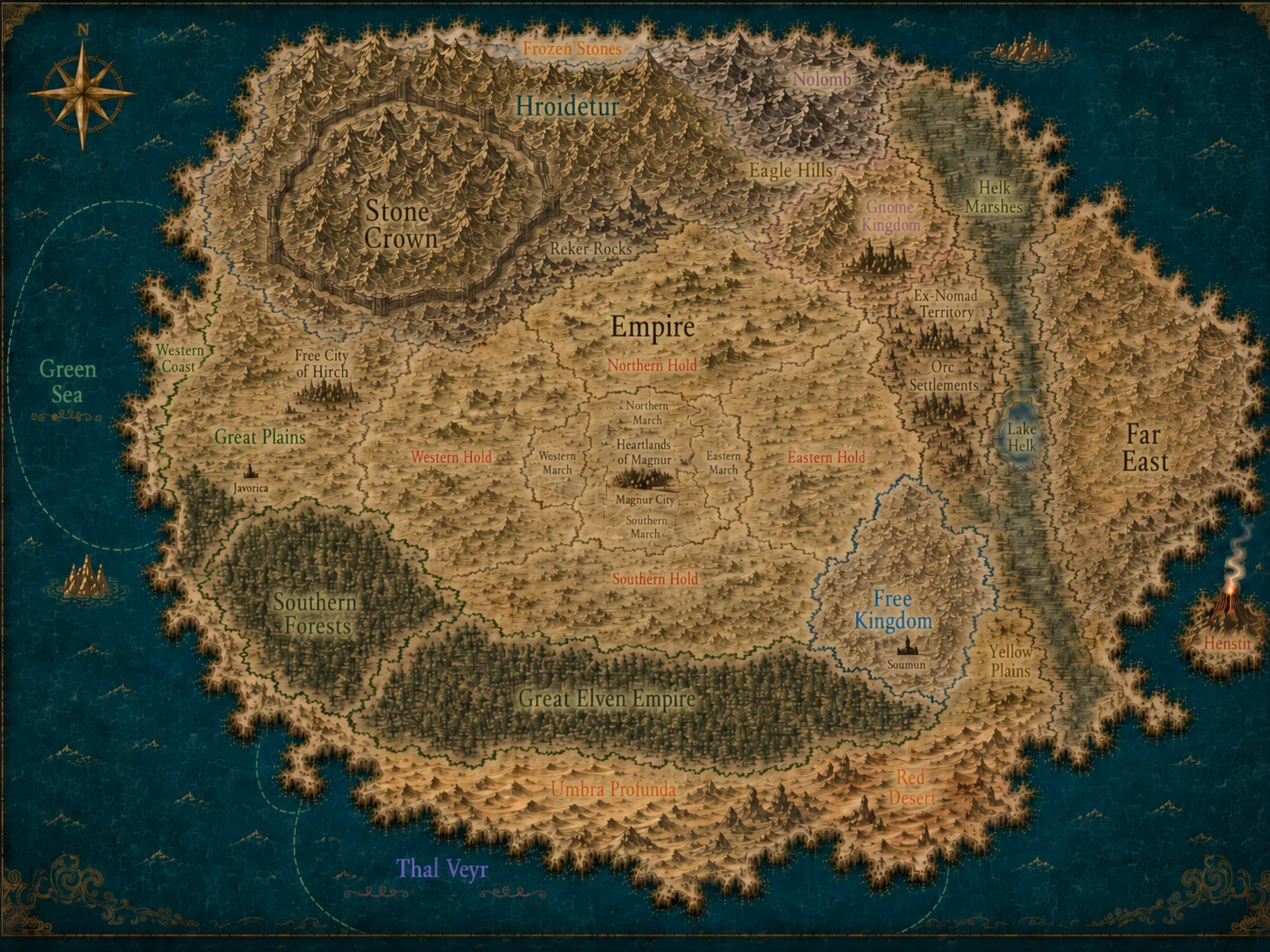
Interactive Map of Ulvenor
Hover over any location label to see a short description. Click to open the detail page.
A Land of Many Faces
Ulvenor is the largest known continent of Oia and the main stage of Howl of Eternity. In size and variety it resembles a vast world-region rather than a single kingdom: mountains, steppes, forests, deserts, marshes, coasts, old roads, and forgotten ruins all belong to the same continental story. Some parts are densely settled and mapped in imperial records; others remain hostile, half-known, or deliberately ignored.
The Heart of the Continent
Central Ulvenor is dominated by the Empire of Magnursar and its capital, Magnur. Imperial roads, fortresses, markets, temples, and administrative towns bind the region together. From the capital, imperial law tries to reach every province, although distance, local custom, noble ambition, and border pressure often decide how much of that law truly survives outside the cities.
North, South, East, and West
The north is a land of cold, mountains, dwarven halls, old passes, and threats that come from ice and darkness. The south carries the memory of elves, deserts, Umbra Profunda, drow power, and strange seas. The east opens toward steppes, orc lands, nomads, Helk, and the distant world of Ghur-Khadan. The west leads toward the Great Plains, kobold cities, centaur tribes, trade routes, and the Green Sea.
Lands, Peoples, and Old Roads
Ulvenor is not a single, uniform world, but a mosaic of many lands, races, and traditions. Each part of the continent carries its own historical memory, its own way of life, and its own relationship with power and war. Elves are tied above all to the south and the great forest regions, dwarves to the mountainous north and the underground roads of the Stone Crown, centaurs and kobolds to the Great Plains and their surroundings, orcs and nomads to the broad eastern lands. Humans have spread across nearly the whole continent, but it is in the centre of Ulvenor that they have built the firmest and most organized state. Travel between these regions is possible, but not always safe. While the Empire has built a network of roads and well-kept routes, the other parts of the world rely instead on forest paths, mountain passes, steppe trails, and ancient trade routes that often pass through lands where law holds only as long as someone can enforce it by force.
A Continent of Stories
Ulvenor is built for many kinds of stories: border adventures, court intrigue, religious conflict, survival in hostile lands, expeditions into ruins, wars of succession, lost knowledge, forbidden magic, and the long consequences of ancient mistakes. No single power understands the whole continent, and that ignorance leaves room for danger, wonder, and heroes.
History

Ancient History of Oia
The history of Oia begins long before the first kingdoms, the first wars, or the first lines written in any chronicle. The planet developed across immense spans of time, and unlike many imagined worlds, its life was not repeatedly erased by total catastrophe. That unusual continuity allowed living things to layer, adapt, and branch into extraordinary diversity. From ancient life forms there eventually emerged the first humanoid ancestors in the lands that would become Ulvenor, later described by scholars as the Alpha humanoids. These first humanoids did not yet create civilization in the later sense, but they carried the foundation of everything that followed. They used simple tools, lived in groups, learned by observation, and slowly became more adaptable. Many millions of years later they gave rise to Beta humanoids, who mastered fire, built the first shelters, formed more lasting communities, and began spreading into very different environments across the world. The greatest break of this ancient epoch was the eruption of the supervolcano Henstir. The blast changed the climate of all Oia, cooled the world, partly froze the oceans, and created temporary land or ice bridges between continents. Some humanoid groups reached distant parts of the world and, once the waters thawed, could never return. Long isolation and adaptation to different biomes became the basis for the later rise of races. Mountains shaped dwarves, forests shaped elves, marshes shaped kobolds, wastelands shaped goblins, the eastern distances shaped orcs, and varied regions shaped humans.
Age of Tribes and Clans
After the races divided, Ulvenor entered a long age of tribes, clans, and early cultures. The peoples were no longer merely regional branches of one humanoid origin. They began to differ in appearance, lifespan, survival patterns, and their relationship to the land itself. Most still lived in smaller communities where power came from a leader's personal authority, the strength of a lineage, the experience of elders, or the spiritual weight of shamans. This age was not an empty pause before true history. It was where the foundations of later nations were laid. Elves learned to live with forests and natural energy. Dwarves turned caves and mountain shelters into the first underground homes. Goblins adapted to wastes and lands of scarcity. Kobolds survived in wet marshes and swamps. Orcs formed in the far east, and humans remained the most flexible and universal branch. As populations grew, the groups began meeting one another again. At first these encounters were mostly conflicts over water, hunting grounds, fertile places, and safe passages. Later, those clashes also produced the first trade bonds, exchanges of knowledge, and the realization that the world was larger than any single bloodline or tribe. Ulvenor slowly changed from a wild continent of separated populations into a place where different races had to learn to live beside one another, against one another, or in permanent tension between both possibilities.
Age of the First Empires
The Age of the First Empires began when some peoples crossed the boundary of tribal life and created the first true states. The elves were the first to do so fully. Around 25,000 years before the imperial calendar, the first great elven kingdom arose and later, through Sylvar, became the First Elven Empire. Elves were long-lived, learned, and closely tied to nature. Because of that, they could build a form of rule that did not depend only on the strength of one leader, but on institution, dynasty, and a spiritual idea of order. The elven rise was not peaceful. Desert goblins from the south and southeast launched stronger and stronger raids, and elven fragmentation became a deadly weakness. Sylvar united the elven houses and defeated the main strength of the goblin tribes in the decisive Battle of Maplewood. This created not only the first great empire of Ulvenor, but also the idea that unity could be stronger than old clan independence. Other powers rose in the same age. Dwarves in the northern mountains built vast underground worlds, halls, mines, and kingdoms that eventually became the Stone Crown after bloody disputes. In the north, the Old Northern Empire emerged as one of the first multiracial states of humans, dwarves, gnomes, and other groups, created as a defense against goblin raids. On the Great Plains, kobold cities grew stronger, and later the centaurs arrived during the Great Migration, beginning one of the longest unbroken conflicts in history. Ulvenor became a continent of first crowns, first great battles, and first historical wounds that would never fully disappear.
Rise of the Human Kingdoms
Humans entered great history later than elves or dwarves, but their strength lay elsewhere. They were shorter-lived, adaptable, and able to absorb foreign knowledge quickly. Where older races relied on tradition and long memory, humans could change government, warfare, and trade within a few generations. The first human kingdoms grew from tribes, towns, and family coalitions that gradually understood they could not compete with older powers without firmer administration. One of the most important old northern states was the Old Northern Empire. It arose as a multiracial realm under Rulik I and was meant to protect the north from goblin raids. For a long time it symbolized stability, but war with Trabazar eventually broke it. The Battle for the New Order showed that old heavy defense and tradition were no longer enough against more mobile tactics, new military methods, and the ability to adapt. The fall of the Old Northern Empire ended one old order and opened the way for new human powers. Magnursia profited most from these changes. In 903 before the imperial calendar, Magnus I the Founder united the nearby human tribes and created the Kingdom of Magnursia. His reign did not look like a vast campaign of conquest, but like the birth of a system. He introduced feudal order, strengthened Magnur, founded the Magnurs dynasty, and created a model of rule that could survive his own death. This began the long story of the state that would centuries later become the Empire of Magnursar.
Magnursia Before the Coming of Magic
The first centuries of Magnursia were an age of consolidation and gradual growth. The early kings had to prove that the new kingdom was not merely the personal work of Magnus I, but a true state capable of surviving crises, disease, dynastic conflict, and foreign wars. Ignac I held the young kingdom together through court politics and the loyalty of lesser nobles. Magnus II the Cursed showed the fragility of the dynasty when leprosy forced him to abdicate. Magnus III the Young then turned family betrayal into a new succession rule, by which the youngest adult son would inherit the throne. Under Otto II the Defender, Magnursia faced its first truly great test in the First War of Kings against Trabazar. The conflict did not end in a clear victory, but the survival of Magnursia itself was a tremendous shift. The kingdom was no longer a young state. It was a power its neighbors had to take seriously. The following era of the Silk Kings brought economic, administrative, and cultural growth. Filip I the Thinker introduced a unified currency, state banks, a more professional army, and a new tax order, making Magnursia one of the most advanced human powers of its time. Yet cracks also appeared in this period. Wealth attracted enemies, trade routes needed protection, the nobility grew in influence, and neighboring kingdoms kept searching for their own place beside a rising Magnursia. The state was stronger than ever, but also more complex, harder to govern, and more vulnerable to crises that could no longer be solved by the personal authority of a king alone.
The Age That Reshaped the World
The Age That Reshaped the World began as old power structures started collapsing under the pressure of new forces. The greatest of those forces was elemental magic. According to the most important tradition, it was brought to Ulvenor by the Sorcer after his mysterious voyage beyond the Green Sea to an unknown western continent. Older forms of natural, shamanic, and spiritual magic existed before, but elemental magic was different. It was more direct, more destructive, more systematic, and far easier for states and armies to use. Magnursia seized this new force faster and more effectively than most rivals. During the age of the Kings of Magic, battle mages became a crucial instrument of expansion. The Battle of Jitron showed that magic could decide entire wars. The Siege of Eagle's Nest confirmed that walls which might once have held for months could fall within days under magical pressure. The old fortress world began to change, and with it the balance between kingdoms. Magic changed more than humanity. The kobolds of Javorica, led by Nuriak, created their own magical tradition and began competing with human schools. Gnomes gradually joined technology and magic. Elves had to accept that humans, whom they had long underestimated, now possessed a tool capable of threatening even ancient realms. All Ulvenor began to move. Weapons, borders, faith, trade, and the idea of power changed faster than ever before.
The Great War and the Birth of the Empire
The greatest break in known history was the Great War. It was not an ordinary conflict between two states, but a long reshaping of the whole continent. Magnursia entered it as a human power that no longer wished to be merely one kingdom among others. Through army, administration, magic, and dynastic ambition it broke old kingdoms, rivals, and parts of the elven world. The Great War changed the map of Ulvenor and proved that older races could no longer rely on ancient superiority alone. The decisive moment came around year 0, when the Kingdom of Magnursia began becoming the Empire of Magnursar. Leo II the Conqueror became the symbol of this transformation. The coronation of the first emperor created a new calendar and a new self-understanding of human power. Humans were no longer merely one of the races of Ulvenor. They began to see themselves as the force that could organize, conquer, and define order across much of the world. The birth of the Empire was not a clean victory without consequences. Elves carried deep wounds from it. Many old kingdoms vanished or were absorbed. Free peoples came under pressure, and the borders of the new empire became places of lasting tension. The Empire brought roads, administration, trade, law, and military order, but also subjugation, taxes, loss of independence, and the long memory of the defeated.
The Imperial Age
After the birth of the Empire of Magnursar came centuries of expansion, consolidation, and recurring crises. Early emperors built institutions, provinces, defensive lines, and the idea of a realm stronger than any single dynasty. Magnur became the capital of human power, the imperial palace became the symbol of rule, and imperial roads became the backbone of administration, trade, and military movement. The Empire expanded into a vast territorial whole joining very different lands, peoples, and layers of history. This age was not an unbroken golden era. The Empire passed through its first decline, succession wars, dynastic changes, and several periods in which its power had to be proven again. The Houses of Render, Ariers, and later Youlender showed that the Empire was not forever tied only to the original founding dynasty. Yet imperial institutions survived. That is one of Magnursar's most important traits: individual emperors may be strong, weak, cruel, or capable, but the system itself continues. During the Imperial Age, several independent counterweights also took shape. The Free Kingdom in the southeast rejected imperial rule and became a symbol of human independence outside Magnur. The gnome kingdom was reduced by the Great War, but survived as a technologically advanced city-state. The Stone Crown remained an ally, not a subject. The Great Plains, elven lands, Ghur-Khadan, Umbra Profunda, and the Green Sea kept their own histories. The Empire was the greatest human power, but it was never the whole world.
The Current Era
In the year 1470 of the imperial calendar, the Empire of Magnursar is no longer at the height of its power. It remains the most important human realm on Ulvenor, but compared with its greatest age it is smaller, more tired, and forced to answer many threats at once. Untred V of House Youlender sits on the throne, a middle-aged ruler who has prevented further losses but rules in a world where merely holding the borders is already a success. In the west, the Great Plains remain unstable because of kobolds, centaurs, and the long war between them. In the east, orc tribes rise and old nomadic regions still remember freedom beyond firm imperial administration. In the north appears the threat of the Lich, an undead lord from the Frozen Stones who may endanger both the Stone Crown and the Empire itself. In the south, tension between humans and elves survives, the old forests remember the Great War, and some wounds remain unhealed after centuries. The current Ulvenor is therefore a world on the edge. Old empires still stand, but they are not unshakable. Magic is more powerful and widespread than ever, gnome technologies are beginning to merge with magical machines, naga kobolds still guard the secrets of the Green Sea, and the unknown western continent remains the possible origin of the greatest magical change in history. The year 1470 is not the end of history. It is the moment just before another great break, when it may be decided whether the old order of Ulvenor survives or collapses under the weight of its unresolved threats.
Empire of Magnursar

Heart of Human Power
The Empire of Magnursar is the most important human state on the continent of Ulvenor and for centuries has represented the center of human political, military, and cultural power. It did not arise as a natural continuation of the old kingdoms, but as the result of the long rise of the Kingdom of Magnursia and victory in the Great War. Around the main story period, in the year 1470 of the imperial calendar, it covers roughly one sixth of the entire continent, making it one of the largest continuous realms in the civilized world. Ulvenor itself is vast and much of its land is uninhabitable, so the Empire's real influence is even greater than it may seem on a map. Its capital is Magnur, an ancient and exceptionally important city located near the central part of the continent. Magnur is the historical heart of the realm, the seat of the imperial court, and the place where administration, power, and dynastic memory have gathered for centuries. Above the city rises the imperial palace, the largest structure on the continent, and its edges are protected by the monumental Lion Walls, named after Emperor Leo III.
Order, Provinces, and Imperial Rule
At the head of the Empire stands the emperor, traditionally styled Emperor of Humans and of the Empire of Magnursar. The title reaches back to the ambition of Leo II the Conqueror, who wanted humanity to become the leading force of a new world. Magnursar is not ruled by a council of races or any similar balancing body. It rests on a carefully built hierarchy of offices, provinces, and noble titles. The vast territory is divided into provinces led by governors or other high administrators appointed or confirmed by central authority. Beneath them stand local title holders, counts, city lords, mayors, and other regional officials. This layered structure allowed the Empire to survive great wars, famines, and dynastic changes. The network of imperial roads also plays a major role in imperial unity, connecting provinces, cities, and fortresses and allowing rapid movement of soldiers, messages, and trade. While most other lands of Ulvenor rely more on traditional paths, forest roads, or regional routes, the Empire has spent centuries building its own transport backbone. Its army is organized around banners, large military formations with their own commands. Since the reforms of Jakob I, this has proved an exceptionally effective way to wage war on several fronts at once.
The Current State of the Realm
In the year 1470, the Empire of Magnursar is no longer at the height of its power. Compared with the age of its greatest glory, it is roughly half its former size, yet it remains the most important human realm on Ulvenor. The imperial throne is held by Untred V of House Youlender, a middle-aged ruler who has reigned only eight years but has already defended the borders and prevented further territorial loss. The Empire does not currently face one single direct enemy leading an open and decisive war against it. Instead, it endures constant pressure from several directions. Small border clashes flare up, some provinces are dissatisfied, old trade and power ties are changing, and in the north a new, much darker danger is rising. In the Ice Mountains appears a prophet called the Lich, who is building an undead army and may become a threat unlike any the Empire has faced in a long time. At the same time, ancient orc tribes are awakening in the east. Their numbers grow and their pressure on surrounding lands increases. The Empire therefore stands in an uneasy balance. It has not collapsed and it is not weak, but it is tired from its own history, its size, and the weight of power it has built across the centuries.
Races

Peoples of Ulvenor
Ulvenor is a continent of many peoples, old bloodlines, and different civilizations. Among the playable races of Howl of Eternity, the most prominent are humans, elves, dwarves, goblins, kobolds, orcs, and centaurs. Each of these races arose in a different environment, survived in a different way, and sees power, honor, tradition, and the future through a different lens. Because of that, their histories never developed in the same direction. Some built ancient kingdoms, some lived for centuries in tribes, and others learned to survive at the edge of civilization while waiting for their chance. One thing is important: the seven playable races do not represent the entire world. Ulvenor is wider, older, and stranger than that. Beside the main races exist other peoples, smaller branches, forgotten lines, and local subspecies that are not commonly available to players but still belong to the living history of the continent. What is playable is only a selected part of what truly lives in Ulvenor.
Old Wrongs, Trade, and Alliances
Relations between races in Ulvenor are complex and rarely simple. Humans spread across much of the inhabitable continent through the Empire of Magnursar and became the main political force of their age. Southern elves still carry the memory of the Great War, lost lands, and the humiliation of watching younger human powers reshape the continent. Dwarves are close allies of the Empire, especially through the Stone Crown, but their loyalty is based on oaths, interests, and memory rather than blind obedience. Kobolds and centaurs remain bound to the Great Plains by a conflict so old that neither side can easily imagine a world without it. Kobolds defend cities, marshes, magic, and old claims, while centaurs defend movement, pasture, and tribal freedom. Goblins are split among cave goblins near dwarven realms, desert goblins tied to southern powers, and other local lines. Orcs in the east are often reduced by western chroniclers to raids and warbands, but they are peoples with their own lands, needs, and political futures. Despite all this, Ulvenor is not only a continent of hatred. Trade, mixed towns, mercenary service, shared enemies, religious pilgrimage, and practical survival create alliances where ideology would fail. A dwarf may distrust an elf and still buy elven medicine. A human official may fear kobold magic and still need a kobold guide. An orc and a centaur may meet as enemies in one story and as comrades in another. Old wrongs matter, but so do roads, hunger, coin, and the choices of individuals.
Races, Subraces, and Playable Lines
Many races contain distinct cultural, regional, or biological lines. Humans include imperial humans shaped by Magnursar, freeborn humans outside imperial rule, and nomads tied to movement and open lands. Elves include forest elves, high elves, and dark elves known as drow, whose histories and social positions differ sharply. Dwarves, goblins, kobolds, orcs, and centaurs also have internal divisions, local identities, and inherited stories that outsiders often flatten into one name. A subrace is therefore not just a cosmetic label. It can mean homeland, language, legal status, social expectation, inherited conflict, and the story other people assume before they know your name. A forest elf entering an imperial city carries different associations than a drow from the south. A cave goblin at a dwarven gate is treated differently from a desert goblin caravan master. A naga kobold from the Green Sea belongs to a different world than a plains kobold from Javorica. Playable lines are chosen so that players can enter the central conflicts of Ulvenor without needing to represent every rare or distant people in the setting. The wider lore may contain many more groups, but the main races and their subraces form the most accessible bridge between character creation and the living world.
The Place of Race in the World
Race in Howl of Eternity is origin, body, heritage, memory, and social position at once. It can open doors or close them. It can make someone a guest, a threat, a curiosity, a legal subject, sacred kin, or an inherited enemy. It shapes how a character is seen before they speak, but it does not decide everything they can become. The world remembers race through politics and everyday life. Imperial officials classify people for taxes, service, and law. Temples preserve myths about divine origins. Villages repeat warnings about old enemies. Merchants learn which customs offend which clients. Border soldiers know that one banner, accent, or body shape can change the mood of a whole road. Adventurers often stand at the edge of these assumptions. They can confirm them, break them, exploit them, or suffer because of them. A mixed party moving through Ulvenor is not only a group of game roles. It is a small political event, a challenge to old stories, and sometimes the only kind of alliance flexible enough to survive a world that larger powers cannot fully control.

Humans are among the most widespread and adaptable races of the world of Ulvenor. Their bodies may lack the natural strength of giants, the longevity of elves, …

Elves are among the oldest races of the Ulvenor world. Their history goes back deep into the times when most other peoples were just looking for their place in …

Dwarves are a nation of stone, iron and unwavering will. Their bodies are as strong and solid as the rocks from which they come, and their spirits are as hard a…

Orcs are among the most inscrutable races of the world of Ulvenor. Unlike humans, elves or dwarves never created large kingdoms or vast empires for a long time.…

Kobolds are a small but extremely dangerous race of lizard origin. At first glance, they may appear inconspicuous—their stature is smaller than most other races…

Orcs are a people of strength, endurance and unyielding will. Their bodies are strong, their natures are stubborn, and their spirits rarely back down from obsta…

Centaurs are among the most remarkable peoples of the world of Ulvenor. Their bodies combine the strength of a horse and the intelligence of a human, making the…

The world of Ulvenor is not only made up of races that players can choose as their characters. In its depths, forests, wastelands, and forgotten ruins, there ar…
Magic

The Origin of Elemental Magic
Elemental magic changed Ulvenor when the Sorcer returned from beyond the Green Sea with knowledge from an unknown western continent. Before that, many peoples knew sacred rites, shamanic traditions, blessings, curses, natural powers, and strange phenomena, but elemental magic gave rulers and scholars a new, repeatable way to shape the world. It became one of the forces behind the rise of Magnursia and later the Empire of Magnursar.
Essence and the Principle of Spellcasting
Spellcasting works through Essence, the force that allows a mage to shape power into an effect. Fire, water, lightning, darkness, mind, and physical force are not merely symbols; they are disciplined paths through which Essence can be focused. The stronger the spell, the greater the strain. Fatigue, injury, loss of control, and death are real risks. Magic is weapon, science, craft, cult, medicine, and survival tool, depending on who uses it and why.
The Spread of Magic Among the Races
Humans institutionalized elemental magic through schools, armies, scholars, and state power. Kobolds reshaped it through Javorica and the legacy of Nuriak. Elves interpreted it through older traditions and suspicion born of history. Dwarves respected its usefulness but never forgot stone, craft, and older forms of discipline. Gnomes pushed it toward machines and magotechnology. Drow, goblins, orcs, naga kobolds, and other peoples each approached magic according to their own needs, taboos, and opportunities.
 Fire
Fire magic draws from the most primal form of Essence — pure destructive energy. Practitioners of fi…
Fire
Fire magic draws from the most primal form of Essence — pure destructive energy. Practitioners of fi…
 Water
Water magic is the most versatile of the elemental disciplines. Water heals, protects, and destroys …
Water
Water magic is the most versatile of the elemental disciplines. Water heals, protects, and destroys …
 Flash
Lightning magic is the fastest and most unpredictable of the elemental powers. Its practitioners sac…
Flash
Lightning magic is the fastest and most unpredictable of the elemental powers. Its practitioners sac…
 Blackness
The magic of darkness draws from the most mysterious currents of Essence—from the shadows, the forgo…
Blackness
The magic of darkness draws from the most mysterious currents of Essence—from the shadows, the forgo…
 Psychic magic
 manipulates the mind, emotions and perception. Its practitioners do not need visible m…
Psychic magic
Psychic magic manipulates the mind, emotions and perception. Its practitioners do not need visible m…
 Physical magic
 strengthens the caster's body beyond natural limits. Its practitioners become living …
Physical magic
Physical magic strengthens the caster's body beyond natural limits. Its practitioners become living …
Religion

Gods of Howl of Eternity
The gods of Howl of Eternity are not distant abstractions. Their signs, visions, blessings, curses, temples, myths, and servants can touch the world directly, even when mortals rarely understand their full will. Auris, Luna, Ignis, Valtor, Nythis, Sylvara, Sekac, the Seven Eternal, Gharmoth, Morgrath, Ithil, and Vhorax all hold places in the religious imagination of Oia. Some are worshiped openly, some feared, and some hidden behind cults or regional names. Religion is therefore not only private belief. It is part of politics, healing, war, funerals, oaths, agriculture, punishment, and dynastic legitimacy. A ruler may invoke a deity to justify law. A village may survive because a local shrine is respected. A soldier may go into battle under a sacred sign. A cult may threaten a city without ever fielding an army.
Faith, Churches, and Divine Favor
Faith varies by region, race, and social class. The Empire tolerates many cults as long as they do not threaten imperial order, while older peoples preserve traditions that predate human temples. Elven worship may treat the natural world and old memory as sacred. Dwarven faith often binds craft, oath, and endurance. Kobold, orc, goblin, centaur, and naga traditions may follow forms that imperial priests only partly understand. A deity's blessing can change a life, a dynasty, or a war, but divine favor is not a simple contract. To worship a god is to enter a relationship of ritual, loyalty, fear, and expectation. Changing faith is difficult because it means changing not only belief, but community, identity, ancestors, and the powers that may be watching. Some deities forgive easily. Others remember. Churches and cults are also institutions. They own buildings, train priests, keep relics, interpret omens, and compete for influence. In some places they protect the weak. In others they guard privilege or hide dangerous secrets. Divine power may be real, but mortals still build imperfect structures around it.
Death, the Underworld, and the Inevitable Judges
Death has its own sacred order. Sekac, Lord of Death, is not merely a figure of fear. He stands as guardian of endings, the one who reminds mortals that every life must eventually reach its final boundary. To many traditions, undeath is horrifying not only because it is dangerous, but because it violates the finality that keeps the world in balance. Beyond or beneath mortal life stand powers associated with judgment, dusk, shadow, and the last reckoning, including Morgrath, Ithil, and Vhorax. Different cultures describe the underworld and the fate of souls in different ways, but most agree that death is not a thing to be cheated lightly. Funeral rites matter because they help the dead pass properly and help the living accept that passage. The rise of necromancy, lichcraft, or armies of the dead is therefore a religious crisis as much as a military one. Such forces threaten villages and kingdoms, but they also threaten the cosmic agreement that the dead should not be dragged back as tools. In a world where the Lich may be rising in the north, the question of death is no longer philosophical. It is political, sacred, and immediate.

Auris is an ancient deity of time, order, and the unseen balance that holds the universe together even when everything else seems to be in …
Neutral
Luna is the goddess of shadows, secrets, illusions, and everything that hides beyond the edge of direct light. Her name is whispered in nar…
Neutral Darkness
Ignis is the deity of fire, war, passion, and destructive force that burns away not only bodies, but also weakness, fear, and doubt. In the…
Chaotic Neutral
Valtor is the god of iron, craft, discipline, and order that does not change according to mortal wishes, but according to the firm laws of …
Lawful Neutral
Nythis is the goddess of deception, magic, seduction, and the quiet hunger for power that grows where others fear even to think. Her adhere…
Chaotic Darkness
Sekáč is not a god of evil, but of inevitability, endings, and the judgment that waits for everyone without exception. He is the guardian o…
Neutral
The Seven Eternal are not a single deity, but a group of ancient entities, each embodying one of the fundamental forces of existence. Their…
Lawful Light
Morgrath is the ruler of the damned, lord of punishment and the shadows in which souls bear the consequences of their own deeds. He does no…
Lawful Darkness
Ithil rules those who are lost, regretful, seeking a second chance, or desperately trying to survive despite their past. She is one of the …
Chaotic Light
Vhorax is the one who receives the souls of fallen heroes, martyrs, and all who dedicated their lives to others. He is one of the three Lor…
Lawful Neutral
Gharmoth was a stranger from another continent who founded a cult in Ulvenor and became a god of insatiable strength, blood, ferocity, and …
Chaotic Darkness
Sylvara is the ancient ruler of the elves and goddess of nature, life, the wilds, and the natural order. During her reign she became a prot…
Neutral LightNations and Realms

The Power Map of Ulvenor
The politics of Ulvenor are shaped by several major powers and many smaller ones. The Empire of Magnursar dominates much of the human world and remains the largest state structure on the continent. The Stone Crown represents dwarven strength beneath the northern mountains. Elven lands preserve old memory, wounded pride, and sacred continuity. Umbra Profunda binds desert goblins, drow influence, and southern secrecy. The Great Plains remain divided between kobold cities, centaur tribes, and contested routes. The Green Sea, the east, orc lands, nomadic territories, free cities, and distant coasts complicate any simple map of power. A border drawn by an imperial cartographer may not match the truth known by a caravan master, a tribal scout, or a village elder. Some powers rule through law, some through oaths, some through fear, some through trade, and some through mobility. This makes Ulvenor politically alive. Even where one realm seems dominant, smaller actors matter: border lords, guilds, temples, tribes, city councils, smugglers, mercenary companies, and old noble houses. The map is not only colored land. It is a web of obligations, grudges, roads, marriages, debts, and threats. This is why political power in Ulvenor is never only a matter of armies. A ruler who controls a road, a pass, a shrine, a harbor, or a market may influence events far beyond the size of their domain. Likewise, a remote tribe or guild can become decisive when it sits between stronger powers. The great realms may write the official histories, but the daily survival of the continent is often decided in smaller places.
Empires, Kingdoms, and Peoples Without Crowns
Not every people rules through an empire or a crown. Magnursar depends on imperial hierarchy, provinces, offices, military banners, and law. Elven power often rests on old houses, sacred places, and cultural memory. Dwarven authority is tied to halls, gates, craft, stone, and oaths. Kobolds mix city power, waterways, magical centers, and local councils. Centaurs follow tribal structures, mobility, and the authority of leaders who can keep people alive on open land. Orcs often organize through clan, war leader, survival need, and personal strength, though western chroniclers frequently misunderstand this as mere chaos. Goblins differ sharply by region: cave goblins, desert goblins, and other lines do not share one political form. Gnomes survive through city institutions, workshops, invention, and usefulness. The Free Kingdom uses a more parliamentary structure and defines itself partly by refusing imperial rule. Because political forms differ, diplomacy is difficult. An imperial envoy may expect seals and written law, while a centaur leader expects personal honor and immediate proof of value. A dwarven council may think in generations, while a human governor thinks in tax years. Much conflict begins when one people assumes that its own form of order is the only real one. These differences also affect law and identity. A person can be a subject of the Empire, a sworn member of a dwarven hall, a free citizen of Soumun, a child of a centaur tribe, or a guest under kobold protection, and each of those positions means different duties and protections. When such systems meet, misunderstandings are not accidents. They are built into the world.
Alliances, Old Wrongs, and Living Borders
Alliances in Ulvenor are real, but never free from memory. The alliance between dwarves and the Empire is important, yet it is built on mutual benefit, old promises, and strategic need rather than simple love. Human and elven relations carry wounds from the Great War and from many smaller humiliations that followed. Drow influence remains feared and poorly understood by outsiders. Kobolds and centaurs can trade one season and fight the next. Borders are living places. They are not only lines between states, but regions where languages mix, taxes are avoided, soldiers grow tired, and old claims become personal. A border village may care less about grand imperial policy than about which patrol arrives before winter, whether the bridge is safe, and which nearby tribe is angry this year. The Lich in the north threatens to make old rivalries into a luxury no one can afford. If the dead begin marching, the Empire, dwarves, free towns, and even old enemies may need to choose between remembered hatred and survival. Whether they can do so is one of the central questions of the current age. Old wrongs do not stay in books. They live in marriage choices, trade refusals, insults at gates, songs taught to children, and the way guards look at strangers. Yet living borders also create people who know both sides, speak several languages, and understand that survival sometimes matters more than inherited hatred. These people can become bridges, spies, traitors, or heroes depending on the story.
Trade Routes, Cities, and the Edges of Civilization
Trade keeps Ulvenor connected even when politics fail. Imperial roads carry grain, silver, soldiers, letters, and law. Elven paths, dwarven tunnels, kobold waterways, centaur trails, naga sea routes, and gnome workshops form other networks of movement and exchange. No single power controls all of them, and that is why information often travels through unexpected hands. Metals, timber, food, magical knowledge, machines, horses, medicine, relics, cloth, books, and rumors move across these routes. So do spies, raiders, deserters, disease, forbidden ideas, and stolen artifacts. A road is never only a road. It is a promise of connection and an invitation to danger. Cities sit at the center of this movement. Magnur, Soumun, gnome workshops, kobold cities, dwarven gates, elven settlements, and southern markets all shape the continent by deciding what may pass, what is taxed, what is forbidden, and what is quietly ignored. The edges of civilization are often where the most important stories begin. Because of this, merchants, guides, and messengers can become politically important without holding formal titles. A caravan master may know which lord is secretly desperate for grain. A tunnel broker may know which dwarven gate is under pressure. A ship captain may carry news from a coast that the imperial court has not yet noticed. Trade turns geography into information, and information into power.
The Balance of 1470
In 1470 the balance of power is unsettled but not yet broken. Untred V holds the imperial throne. The Free Kingdom watches for weakness. Gnomes guard their inventions. Dwarves weigh loyalty against survival. Elves decide how much of the present they are willing to enter. Kobolds and centaurs keep the Great Plains tense. Orcs stir in the east, and the north grows darker with rumors of the Lich. The map still looks stable in official halls. Treaties exist, borders are drawn, taxes are collected, and rulers speak as if the world remains understandable. But many of those borders are already moving in people's minds. A governor wonders whether Magnur can still protect him. A tribe wonders whether now is the time to move. A merchant wonders which road will be safe next year. A priest wonders whether the omens are warnings or judgments. The balance of 1470 is therefore not peace. It is held breath. The old powers remain strong enough to avoid collapse, but not strong enough to silence every threat. That is what makes the age dangerous, and what makes it full of opportunity. Everyone can feel that the old arrangement still functions, but fewer people trust that it will last. The next major crisis may not redraw every border immediately, but it can change which promises people believe, which roads they dare use, and which rulers seem worth obeying. That is how the balance of power often breaks: first in confidence, then in law, and only later on the battlefield.
Important Places

Magnur - Heart of the Empire
Magnur is the capital of the Empire of Magnursar and the symbolic heart of human imperial power. Dynasties rise and fall in its palaces, laws are sealed in its offices, and the Lion Walls remind every visitor that this city was built to endure siege, ambition, and memory. For many citizens, Magnur is civilization itself; for many enemies, it is the face of imperial arrogance. The city is more than a seat of government. It is a living archive of imperial history, full of temples, noble districts, military offices, markets, schools, and streets where decisions made far away become taxes, orders, and judgments. The imperial palace towers above the city as the largest structure on Ulvenor, and its presence shapes how people think about power. Magnur does not merely rule. It teaches everyone who enters what rule is supposed to look like.
The Stone Crown - Realm Beneath the Mountains
The Stone Crown is the great dwarven realm beneath the northern mountains. Its halls, gates, mines, and old seats of power are tied to families, craft, oath, and survival underground. Symbolic authority shifts among places such as Kauranvyr, Rautakallio, and Akmenrudis, and each of them carries a different part of dwarven memory. The realm is not only a fortress, but a civilization of stone, metal, law, and inheritance. Dwarven power depends on gates that can be closed, tunnels that outsiders do not know, and oaths remembered for longer than many human dynasties last. The Western Gate faces the world of cave goblins, while the Northern Gate watches cold lands where rumors of the Lich grow darker. The Stone Crown is an ally of the Empire, but it is not an imperial province. Its loyalty is chosen, negotiated, and guarded.
Umbra Profunda - The Deep Shadow of the South
Umbra Profunda lies among southern deserts, steppes, hidden cities, and hard roads. Desert goblins, drow power, and old mysteries shape the region. Names such as Vael'Zakar, Sha'Khalir, and Nyr'Azhar carry weight here, and outsiders rarely know which ruler, cult, house, or memory truly controls the ground beneath their feet. The region is feared because it is difficult to understand from the outside. Its politics are layered, its loyalties are hidden, and its cities often appear in northern stories as shadows rather than places. Yet Umbra Profunda is not empty darkness. It contains trade, knowledge, faith, cruelty, beauty, and a political culture shaped by harsh land and deep secrecy. Anyone entering it with simple assumptions is already in danger.
Thal Veyr - The Dark Sea of the Drow
Thal Veyr is the dark southern sea associated with drow power, strange creatures, dangerous voyages, and ruins most sailors would rather not name. It is less a border than a warning: beyond familiar coasts lie waters where old forces may still move unseen. The sea matters because it connects fear with possibility. It may hide routes, sunken places, living powers, and histories that surface only in fragments. For coastal peoples, Thal Veyr is not a distant legend but a presence felt in storms, missing ships, forbidden maps, and stories told quietly in ports. To sail there is to accept that the known world has edges, and that some edges look back.
The Great Plains - Land of Kobolds and Centaurs
The Great Plains are a vast region of grasslands, wetlands, roads, rivers, cities, and tribal territories. Kobold centers such as Javorica and Hirch preserve magic, trade, and old claims, while centaur tribes defend mobility, pasture, memory, and freedom. The region is alive, wealthy, dangerous, and almost impossible for any outside state to control completely. The plains are contested because both kobolds and centaurs have real histories there. Neither side is merely an invader in its own story. Some areas know trade and truce, while others can erupt over a water route, a shrine, or grazing land. For the Empire, the Great Plains are a strategic headache. They are too important to ignore, too wide to occupy easily, and too culturally complex to govern by simple decree.
Ghur-Khadan - The Far East of the Orcs
Ghur-Khadan is the far eastern world of orc peoples, clans, settlements, war leaders, and half-known histories. For western Ulvenor it is often reduced to rumor, threat, or border tale, but it is a living region shaped by its own needs and memories. Helk and great distances long kept it apart from imperial politics, but that separation may be weakening. The east is not a single army waiting on a map. It contains rival groups, ambitions, migrations, trade possibilities, and leaders who may or may not become dangerous to the west. Some orcs seek land, others glory, others survival, and others contact. The danger of Ghur-Khadan is not only that it may attack. It is that western powers understand it badly, and bad understanding turns movement into panic very quickly.
Helk - Lake and Marshes Between Worlds
Helk is the largest lake and marsh barrier between western Ulvenor and the far eastern orc lands. It is a place of water, mud, fog, routes, hiding places, and contested crossings. Whoever understands Helk can move between worlds that many mapmakers prefer to keep separate. The region matters because it is both obstacle and passage. Armies struggle there, smugglers thrive there, guides become invaluable, and rumors cross where official roads do not. Marsh villages, hidden paths, old ruins, and dangerous waters make Helk a place where geography becomes politics. Control of Helk is never absolute, but knowledge of it can decide whether the east remains distant or suddenly arrives at the doorstep.
The Green Sea - Home of the Naga Kobolds
The Green Sea lies to the west and is tied to naga kobolds, underwater cities, uncertain trade, and the ancient route by which the Sorcer once returned with knowledge of elemental magic. For most land peoples it remains half-mythical, but beneath its waters are civilizations that cannot be conquered by ordinary armies. Its importance reaches far beyond navigation. The Green Sea is connected to the greatest magical transformation in known history, to the unknown western continent, and to peoples whose politics unfold beneath the surface. Naga kobolds guard secrets that imperial scholars can barely approach. Any expedition into these waters is therefore not only a voyage, but a challenge to the limits of what Ulvenor thinks it knows.
Albarit - Eastern Continent of Monsters and Secrets
Albarit is the distant eastern continent associated with dragons, Gharmoth, the legacy of vampires, unknown empires, and dangers that Ulvenor only partly understands. If even a fraction of the old stories are true, Albarit proves that Ulvenor has never been as isolated as its rulers like to believe. For most people, Albarit is a name on the edge of maps and myths. For scholars and sailors, it is a warning that other continents have their own histories, powers, and disasters. Forces that once came from Albarit may already have changed Ulvenor, whether through monsters, bloodlines, cults, or lost knowledge. It is a reminder that the known world is only one stage of a larger and more dangerous history.
The Unknown Western Continent - Origin of Elemental Magic
Somewhere beyond the Green Sea lies the unknown western continent from which the Sorcer brought the knowledge that changed Ulvenor. No one from Ulvenor has returned with a reliable map, a full account of its cities, or certain news of its peoples. Yet its influence transformed the entire continent, because elemental magic entered history through that voyage. After returning, the Sorcer founded a school, or perhaps a cult, that taught the use of Essence through individual elements. This magic spread quickly, changed warfare, enabled the rise of Magnursia, and indirectly helped create the Empire of Magnursar. An older mystery reaches back to the eruption of Henstir, when ice bridges may have formed between continents. Some ancient humanoids may have crossed westward, and their descendants may live in a land that knew magic far earlier than Ulvenor.
The Free Kingdom - A Human Realm Without an Emperor
The Free Kingdom lies southeast of the Empire and is one of the few independent human states not ruled from Magnur. It arose in 294 of the imperial calendar around the city of Soumun, when southeastern inhabitants rebelled against imperial administration. Their grievance was that the Empire, in their eyes, had failed to protect their lands properly against raids from the east. Today the Free Kingdom is a unusual political realm that relies more on parliamentary government than classic monarchy. Its towns and villages are multiracial, home to humans, orcs, nomads, gnomes, centaurs, and other minorities. Soumun is its capital, while the southeastern Yellow Plains recall the original homeland of the centaurs. The Free Kingdom is a symbol of human independence outside the Empire, but also a place of corruption, caste divisions, and political ambition.
The Gnome City-State - Technology Between Realms
The gnome kingdom, now more of an advanced city-state, is one of the most important centers of technology, invention, and magotechnology in Ulvenor. It was founded in 1800 before the imperial calendar by the union of gnome tribes northeast of Magnur and south of the Sharp Rocks. At its greatest height it was among the most advanced states on the continent, but the Great War reduced it sharply. Gnomes survived because they were useful. Their technology long resisted larger powers, and even after the rise of magic they kept a unique position. Over time they began joining machines with magic, creating automata, mechanical creatures, defensive constructions, and devices powered by crystals. Their state is not large, but its importance reaches far beyond its walls. In Ulvenor politics, a small people survives when it is too clever and too useful for great neighbors to destroy.
Current Era (1470)

A Year of Uneasy Balance
The year 1470 of the imperial calendar is not an age of open world war, but it is certainly not an age of peace. Ulvenor has entered a tense balance in which old powers still look solid while exhaustion, mistrust, and fear gather beneath the surface. The Empire of Magnursar remains the largest human realm on the continent. Its roads still carry armies, merchants, and official seals, and Magnur still feels like the heart of the civilized world. Yet fewer people believe the Empire stands at the height of its power. The current era is strange because nothing has collapsed yet, but almost everywhere people can feel that something is coming. Border provinces are restless, trade routes grow less safe, old peoples again follow their own interests, and smaller states wonder whether imperial weakness is a threat or an opportunity. Many townspeople still live ordinary lives, pay taxes, trade, and watch local disputes, but messengers, soldiers, scholars, and nobles already sense the continent beginning to move. Ulvenor in 1470 therefore does not feel like a world after catastrophe, but like a world just before one. The walls still stand, laws still function, agreements are still made, and markets, weddings, and holy days still happen. Yet reports grow more frequent: lost expeditions, strange signs in the north, orc movements in the east, tension on the Great Plains, and political speeches that no one would have dared say aloud a few decades earlier.
Magnursar After Its Peak
In 1470 the Empire of Magnursar is still the most important human power on Ulvenor. It is not broken, helpless, or empty of strength. Its banners guard borders, imperial roads link provinces, officials collect taxes, and the capital of Magnur still decides the fate of millions. But the realm is no longer as confident as it was in its age of greatest glory. It is smaller, more tired, and more focused on maintaining order than on further expansion. Untred V of House Youlender sits on the throne. He has ruled only eight years, yet he has already become known as the emperor who prevented further territorial losses. In the present age, that alone is an achievement. His problem is not one great enemy who can be defeated in a decisive battle. The Empire is bleeding in many places at once: raids on one border, noble discontent elsewhere, shortages in another province, and distant governors wondering whether Magnur is still close enough to fear. Imperial power now rests above all on the system: roads, fortresses, offices, military banners, and the tradition that the Empire must continue. That tradition is becoming dangerously heavy. Each generation inherited another fortress, another border, another dispute, another debt, and another memory of glory that must be defended. Untred V does not rule an empire ready to conquer the world. He rules one trying not to lose what remains.
Borders That Are No Longer Certain
The clearest sign of the present age is the border. On maps borders look like firm lines, but in reality they are belts of fear, trade, smuggling, patrols, old claims, and small battles that often never enter official chronicles. The Empire has defensive lines, fortresses, and banners, yet it cannot guard every pass, forest path, or dry riverbed where a smaller group of raiders might move. The western border toward the Great Plains remains unstable because of kobolds and centaurs. Most of their conflicts are internal to the plains, but imperial borderlands suffer from raids, theft, caravan attacks, and reprisals. To local people it does not matter whether the incident was a great war or a raid by a few dozen riders. If a barn burns, cattle vanish, or a patrol dies, the border becomes very real. In the east the situation is even more complex. Orc tribes and eastern peoples are not one unified enemy that can be marked easily on a map, but their pressure is growing. Some tribes migrate, some search for resources, and others test the strength of their neighbors. The eastern lands of the Empire and nearby states therefore feel like a region where the old order could change very quickly. If one strong leader unites several tribes or exploits a slower imperial response, a border problem may become a war.
The Shadow from the North
The darkest threat of the present age has not yet arrived under open banners. In the cold and forgotten north, reports of the Lich are beginning to spread. Many dismiss them as superstition, merchant tales, or military excuses for more defensive spending. Yet northern expeditions vanish, old ruins seem silent in a different way, and some patrols report things that cannot be explained by banditry or winter. The Lich is dangerous because he does not behave like an ordinary conqueror. He does not build an army in the open, declare war, or send envoys with demands. He grows quietly. Every dead body may become a future servant, every lost expedition may strengthen his forces, and every destroyed settlement may be one more stone in something larger. While ordinary realms need supplies, loyalty, and living soldiers, the Lich's power can grow from places others consider empty. If the northern threat proves real, it will not be just another war. The Empire and the other peoples of Ulvenor are used to fighting living enemies who know fear, hunger, fatigue, and internal dispute. An undead army would be a different kind of danger. Such an enemy does not retreat because of winter, negotiate truces, or stop because it lost many soldiers. That is why the northern threat may force hostile peoples to consider alliances they would normally reject.
The East Awakens Again
The far east, known among orcs as Ghur-Khadan, was long a distant and poorly understood world to most of western Ulvenor. Orc tribes lived there in their own way, divided among settlements, kin groups, and rival leaders. For the Empire they were often a border story, a source of mercenaries, or a scattered threat rather than a single force. In recent decades, that image has begun to change. Reports speak of tribal movement, new war leaders, crossings near Helk, and growing orc interest in western lands. It is unclear whether this is the beginning of a great migration, a series of unrelated movements, or the first step toward something more organized. The problem is that the Empire cannot afford to wait until the answer is obvious. If eastern pressure joins the internal exhaustion of the Empire, old borders may prove far more fragile than they seemed. Orcs are not only raiders. They are inhabitants of their own world, long isolated by Lake Helk, marshes, and distance. Some seek trade, others glory, others new land. This diversity is precisely the problem for western states. Orcs cannot be treated as one empire, but they cannot be dismissed as scattered tribes without a future. If a true unifier appears among them, the east may become one of the greatest forces of the coming age.
The Great Plains in Permanent Tension
The Great Plains remain one of the most alive and unstable regions of Ulvenor. For kobolds they are home: an old land of wetlands, cities, magic, and defended borders. For centaurs they are a new homeland after ancient migration: open space for freedom, movement, and tribal identity. Both peoples have a legitimate relationship to the plains, which is why their conflict has never fully ended. The current age is no exception. Some areas know truces, trade, and careful coexistence. Elsewhere, one dispute over a path, pasture, marsh, or old shrine can ignite a local war. Kobold cities such as Hirsch and Javorica are centers of culture, trade, and magic, but beyond their influence lie wide territories where speed, terrain knowledge, and tribal strength decide survival. For the Empire, the Great Plains are a problem that can never be fully solved. They are too wide, too restless, and too foreign to imperial administration. Any attempt at hard control would be expensive and probably unsuccessful. At the same time, Magnur cannot ignore them, because raids, trade opportunities, magical knowledge, and new political threats may all come from the plains.
Smaller States Between Caution and Ambition
Current Ulvenor is not made only of the Empire and old racial powers. Smaller states matter as well, surviving between larger neighbors through diplomacy, trade, clever law, or a special strength of their own. The Free Kingdom in the southeast is a human state whose existence reminds everyone that not all humans accept imperial rule as the natural order of the world. Its independence is a political symbol and a permanent source of tension. The Free Kingdom is not strong enough to break the Empire by itself, but it is important enough to influence trade, border politics, and the mood of neighboring provinces. Its towns and villages mix humans, orcs, nomads, gnomes, centaurs, and other minorities. That diversity gives it strength and weakness at once. It is more open than the Empire, but also more internally fragmented. The gnome city-state is another form of survival. Reduced after the Great War but still technologically extraordinary, it has remained independent by becoming useful. Its technology, machines, magotechnology, and mechanical constructions are desired and feared. Gnomes know that larger realms value small states only while they need something from them. They therefore try to make their inventions so valuable that no neighbor will want to destroy them too quickly.
Seas, Coasts, and the World Beyond Ulvenor
While inland powers argue over borders, taxes, and armies, coastal regions remind everyone that Ulvenor is not the whole world. The Green Sea in the west, Thal Veyr in the south, and distant Albarit in the east raise questions most rulers cannot fit comfortably into ordinary politics. What lies beyond the sea? Who already knows of Ulvenor? How many ancient influences have touched the continent without its modern empires admitting it? The Green Sea is tied to naga kobolds, underwater cities, and the old route of the Sorcer, which indirectly brought elemental magic to the Empire. For most land peoples the naga remain almost mythical, but their existence proves that some civilizations cannot be conquered by ordinary armies. Beneath the surface are cities, trade routes, and political relationships that appear in imperial maps only as uncertain notes. Thal Veyr in the south is darker and less understood, linked to drow power, deep creatures, dangerous voyages, and waters that perhaps should remain undisturbed. Albarit is a still greater question. If Gharmoth, vampires, dragons, or other forces once came from there, Ulvenor has never been as isolated as its inhabitants like to think. The current age may therefore become a new age of discovery, or the return of threats the continent forgot long ago.
Magic, Technology, and the Change of the Old Order
One of the greatest differences between the present and older ages is the spread of magic and its deeper connection to states, war, and daily life. Elemental magic is no longer an incomprehensible novelty or the privilege of a few legends. It has schools, traditions, scholars, soldiers, and opponents. Yet it remains a force that can never be fully tamed. Any powerful mage can be a blessing to a state and a threat to it. Kobolds are among the peoples that adapted magic to their own identity. Javorica and the legacy of Nuriak show that magic does not have to be only a human tool. It can become part of another racial tradition. Gnomes responded differently: they did not merely imitate magic, but began joining it to machines. The result is magotechnology, mechanical constructions, automata, and inventions that may change the shape of war and labor. The present age is therefore also an age of technical and magical shift. The old feudal and tribal world still exists, but something new is being born beside it. Machines, potions, magical schools, defensive automata, elemental weapons, and underwater artifacts slowly undermine the certainty that soldiers, land, and old blood alone decide the future. Some see progress in this. Others see the beginning of decline.
Events That May Come
The year 1470 is best understood as a starting point for great stories. Not because everything has already happened, but because many things are on the edge. If the Lich acts openly, he may force the Empire, dwarves, gnomes, and other peoples to cooperate against a threat no state can defeat alone. If the orc tribes unite, the eastern border may become a new war zone. If the Great Plains ignite on a larger scale, the Empire and kobold cities will have to react faster than they would like. In the Free Kingdom, voices calling for a more active policy against the Empire may grow stronger. Gnome technologies may become targets of espionage, theft, or guild war. Elves may have to decide whether they remain a historical monument to their own glory or try again to shape the world actively. Drow from Umbra Profunda may use the tension of northern realms to strengthen their own influence. The seas may bring news that changes what people believe about the limits of the known world. The greatest danger of the current age may not be one specific threat. It may be that many threats move at the same time. The Empire can survive one war, perhaps even two crises. But if the north, east, western plains, internal provinces, and sea borders all shift together, 1470 may become the beginning of an age in which the old order of Ulvenor is no longer enough.
A World Ready for Heroes
The present era is ideal for adventuring stories because great powers cannot be everywhere. An emperor can give an order, but by the time it reaches a distant border, a village may already be burned. A governor can promise protection, but with too few soldiers he must rely on local allies. A dwarven king can lock a gate, but a forgotten tunnel may remain open below. An elven adviser can warn of an old curse, but someone must enter the forest and learn the truth. In such a world, individuals matter. A party can save a border settlement, expose noble treason, find proof of the Lich's army, negotiate peace between tribes, recover a gnome invention, pass through naga lagoons, or bring news from places no army can reach. Not because heroes are stronger than empires, but because empires are slow and the world changes faster than their officials can record. The year 1470 is therefore the present, but also an eve. The old realms still stand, the old races still remember, and the old roads still cross the land. Yet beneath all of it a new movement has already begun. In that movement it will be decided whether Ulvenor enters the next age as a continent that survived its own past, or as a world where old mistakes return in a far worse form.